

AMSTERDAM, Netherlands — I’m a big fan of universal languages.
Whether it’s sports, music, or art, I believe there are certain things that connect us no matter what language you speak.
That’s one of the things I’ve always enjoyed about traveling, you see the world, you learn, and at the same time you learn a bit about how the human experience can feel pretty universal when looking at the brush strokes on Vincent Van Gogh’s Sunflowers or watching a curling shot from the top of the box into the upper corner.
Whether it’s Dutch or English, or any other language, the moment hits you as a person.
That’s one of the reasons I went to Amsterdam with my wife this past week, sure it was to celebrate our anniversary (we’ve now been married 14 years), but it was also to watch a couple concerts (Audrey Hobert at the Melkweg), look at some awesome art, and take in an Eredivisie soccer game between FC Utrecht and AZ Alkmaar while also exploring a new city.
The trip wasn’t supposed to include hockey. It was supposed to be a reprieve from work, a reprieve from the sport before we really start diving headfirst into the craziness of the NHL trade deadline this week.
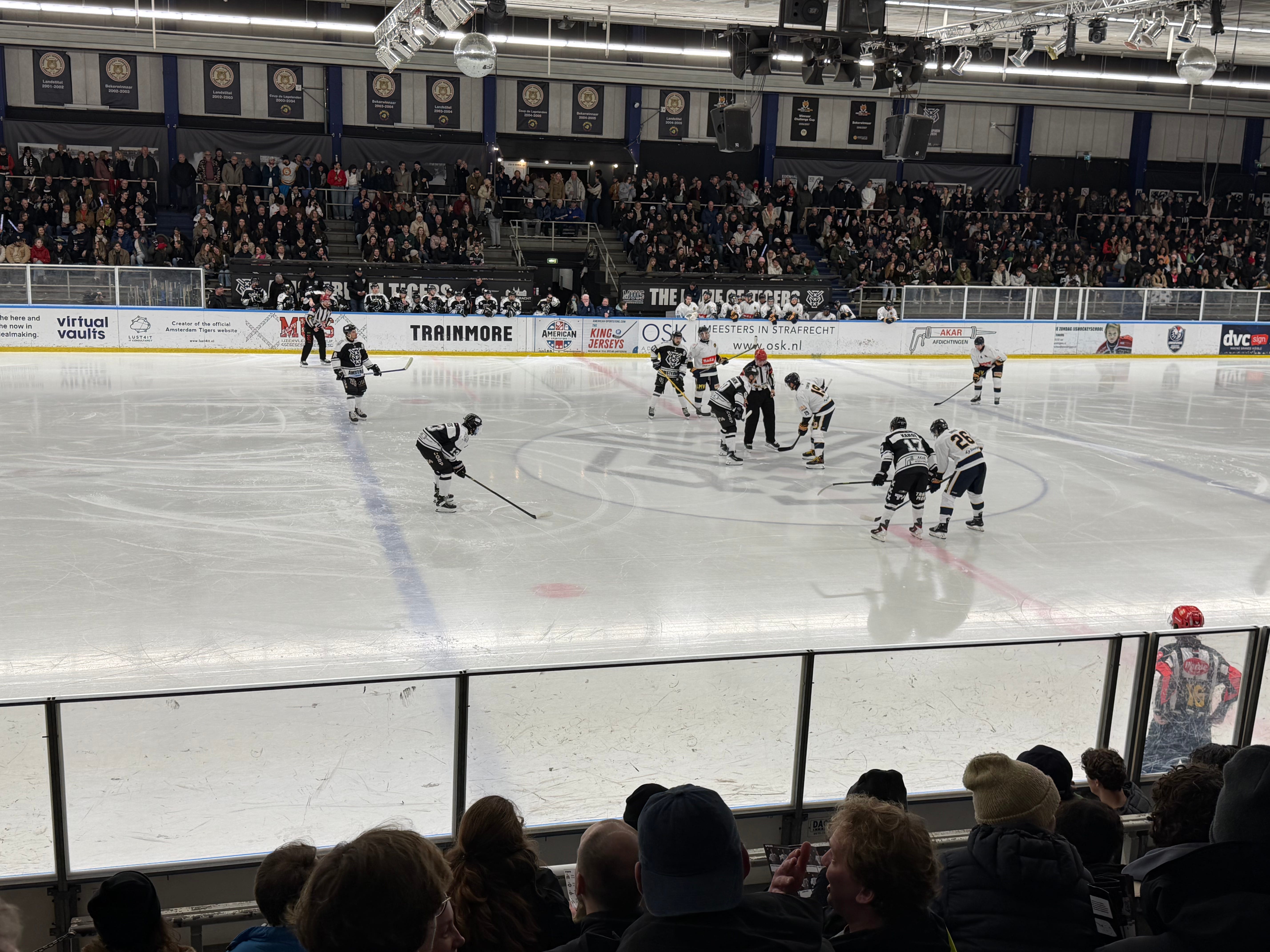
But hockey is also a universal language, and when we all of a sudden had a free night on Saturday because the soccer match was moved to Sunday, we decided to take an in-person deep dive to Dutch hockey and I found tickets to Game 1 of the quarterfinals of Eredivisie (ice hockey version) between the Amsterdam Tigers and visiting Zoetermeer Panthers.
Before we get to the game itself, I think it’s important to establish how little I really knew about hockey in the Netherlands beyond what I’d heard about if from former NHLer Daniel Sprong, who used to play for the Detroit Red Wings.
Sprong, who now plays in the KHL, was born in the Netherlands but was raised in Canada. He has dual citizenship, and if he wanted to, he could play for the Dutch national team, which currently competes at the IIHF Division I, Group B level for World Championships.
Sprong told me he didn’t play for the Netherlands for two primary reasons: he wanted to keep his options open to potentially play for Team Canada and he wasn’t sure the return on investment was worth it to play in the lesser tournaments, even though he believed full heartedly he was probably good enough to at a minimum get the Dutch into the championship and potential promotion to the Division I, Group A level.
So going in my vision of Dutch hockey was very North American centric, that ice hockey probably didn’t exist. It’s a nation of speed skaters and field hockey athletes, but those two didn’t really crossover.
In fact, at breakfast on Saturday, the day of the game, we asked our waiter if he’d ever been to an ice hockey game. He hadn’t, in fact he double checked to make sure we weren’t asking about field hockey.
So I went into this with muted expectations, we took a 20-minute tram ride, left the tram turned left and instantly saw a gaggle of people wearing hockey jerseys. I turned off the mapping app in my phone, and we followed the crowd.
One of the things I often miss out on as a media member is the proper game-day atmosphere. I’m often at the building before most fans arrive and leaving after they’ve filed out, you can see the vibe from the press box, but it’s not the same as living and breathing it with other fans — and that’s really why we love sports, right? That communal experience.
As a hockey fan, no matter the team, being in a strange place and seeing a jersey can give you a bit of a “home” feeling, the understanding that while this might not be the game or league you’ve typically watched, people in jerseys marching toward a stadium is the universal sign to follow the crowd. It doesn’t matter how we got here, but we all are going to the same place.
And tucked into a small neighborhood in southwest Amsterdam, we found the Jaap Edenhall.
There were rows of bike racks filled in front of the arena, there are more bikes than people in the Netherlands, with a line wrapping out of the arena. As part of the main sports complex there was also an outdoor skating track, used for speed skating, which was filled with both advanced skaters and families taking a lap in the spring weather.
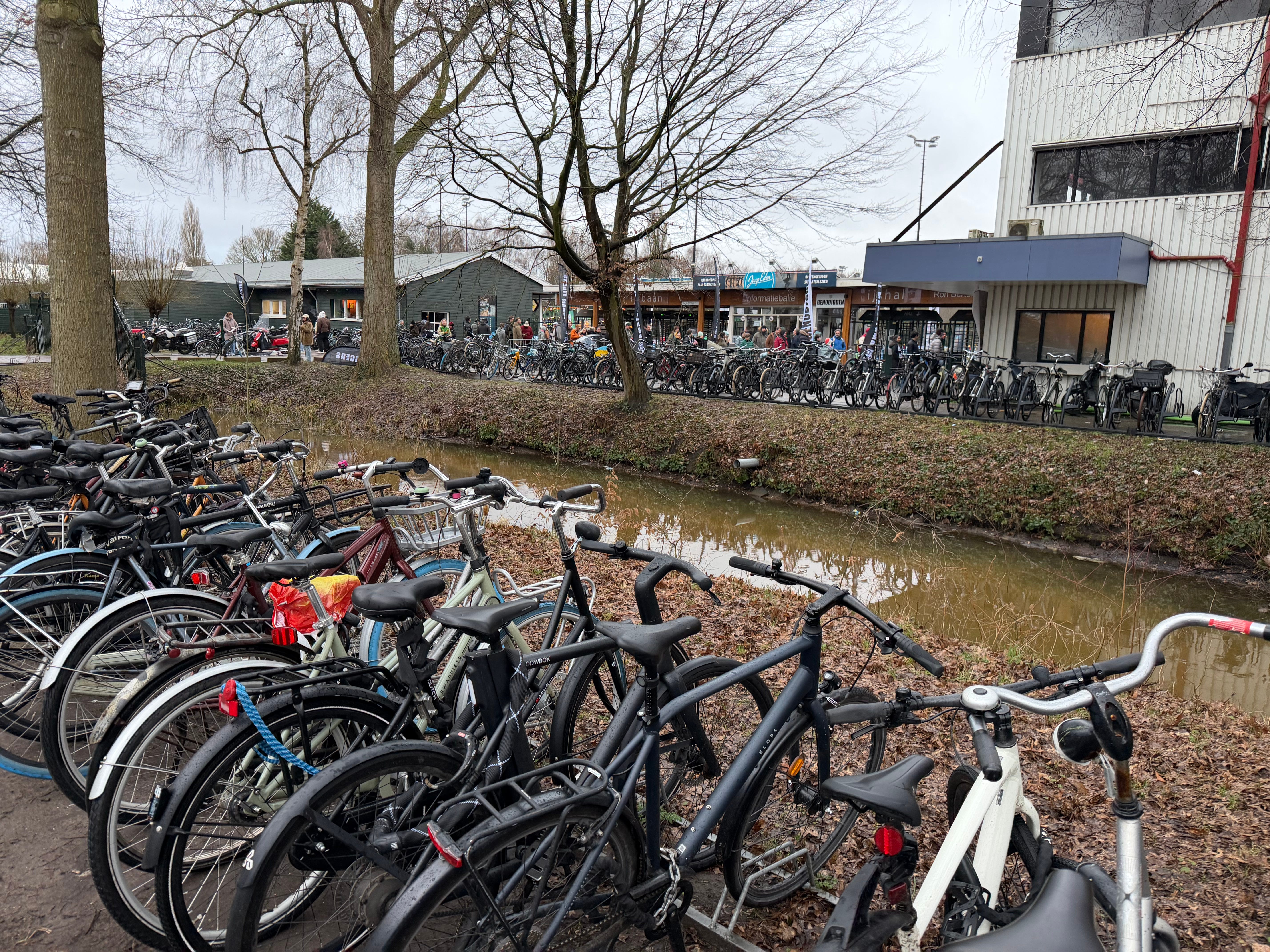
We entered the building with about 10 minutes left in warmups and we couldn’t find a seat. Aside from two sections for VIPs, it was general admission tickets, free-for-all and all of the good seats had been taken. It was also sold-out, standing room-only and after buying an Amsterdam Tigers hat and scarf — scarves need to be a bigger part of North American sports culture in my view — we grabbed an ideal spot to stand on the concourse equal with the blue line.
This story isn’t about the quality of play on the ice, I think it’s important to note that. The Eredivisse is technically the second-highest league in the Netherlands below the Central European Hockey League which houses three Dutch teams as well as four Belgian and two German teams. Some of the better players on both teams had experience in Finland playing as depth players in Mestis, the second Division in Finland.
It’s not a glorified beer league, I think that’s unfair, but it’s also not the league anyone dreams of playing in. If you’re an import playing in the Dutch league you’ve likely stumbled upon an opportunity to extend your career or you were already in the Netherlands for something instead of hockey in the first place.
But this story is about the human experience, the fact that close to 2,000 people on a Saturday night in Amsterdam jammed themselves into an arena to watch ice hockey. It’s about the universal language of sticks clattering, pucks booming off the boards, and that beautiful kssh, kssh of skates cutting through ice, interjected with fans “oohing” and the apparent universal language of “ref you suck!” after a call was made against the Tigers.
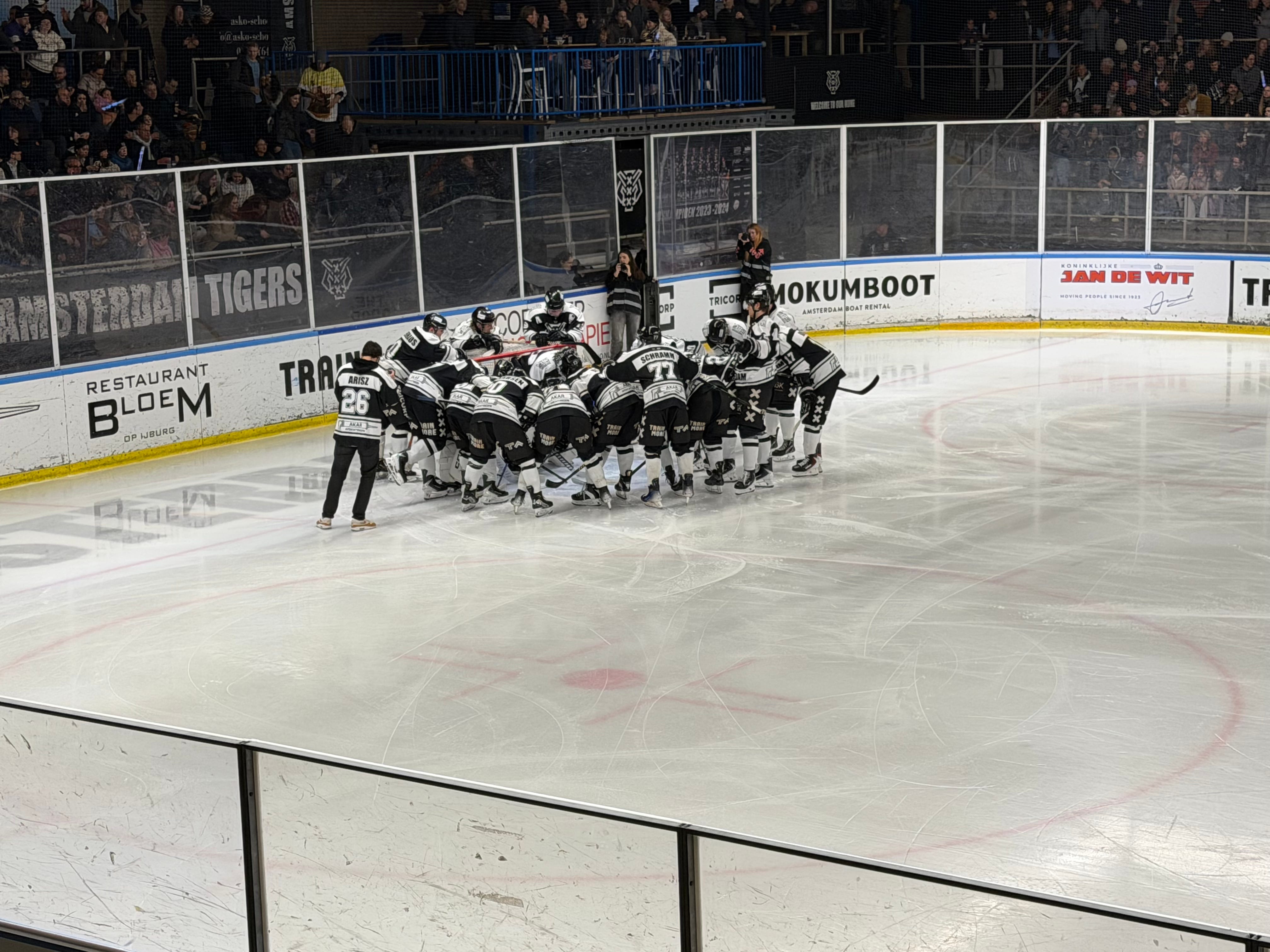
All of the announcements were in Dutch, other than some hockey staples, “power play” for example and the player’s names, we couldn’t understand a word. There was also no video board and with a lower roof, it felt like I was back in college at the rink at Bowling Green State University — affectional known as the “Madhouse on Mercer” — where sounds bounced and reverberated back-and-forth, the full immersive soundscape you rarely get in an NHL building.
It was also a lesson or reminder that once you immerse yourself in the moment, the game always connects. The NHL is the best league in the world, no one disputes that, but I truly believe someone can have just as much fun hockey-wise watching at any competitive level if the game means something to those on the ice and in the stands.
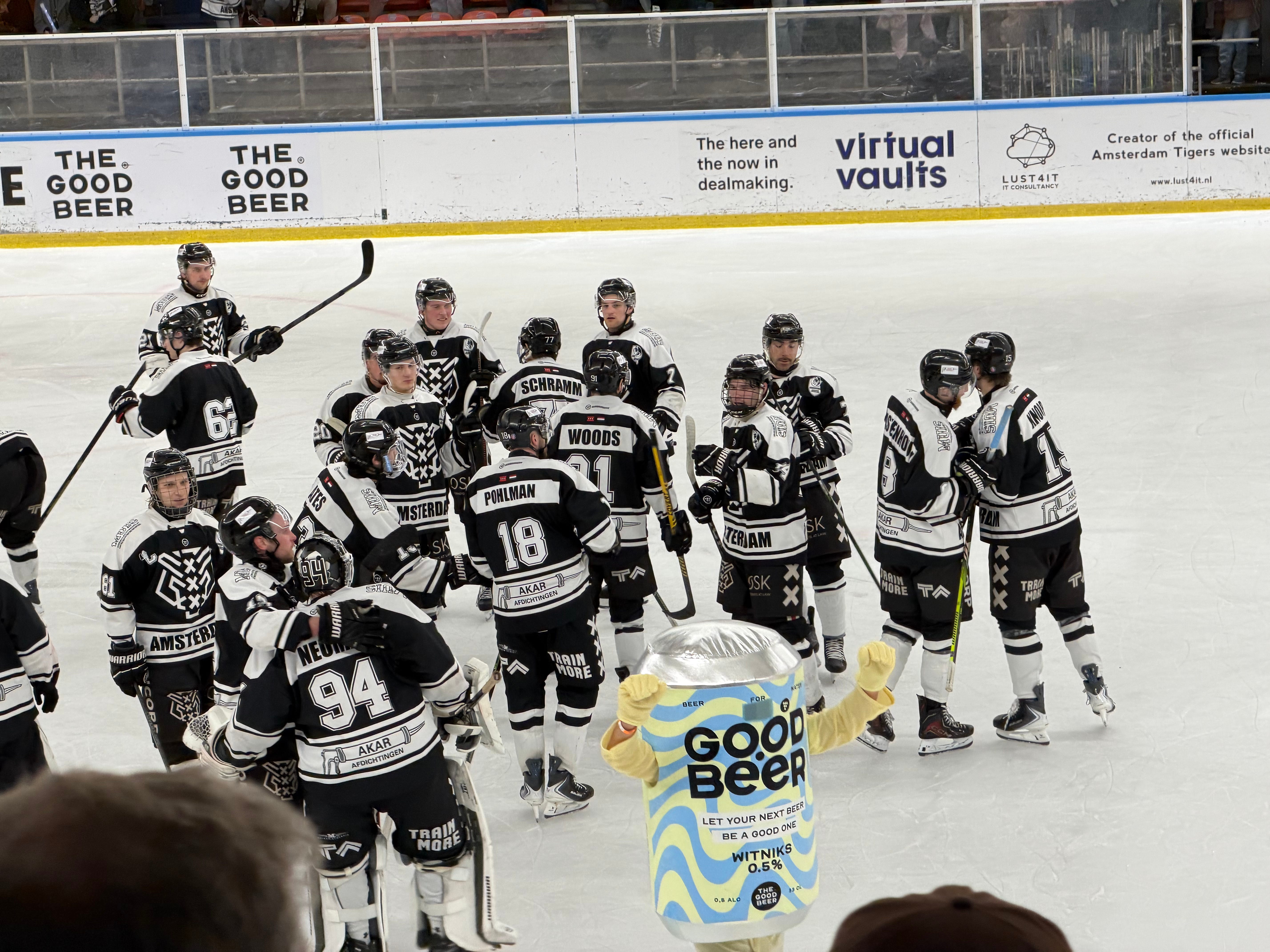
And this was playoff hockey. Amsterdam, the second-seeded team out of the regular season, was pretty clearly the better team at 5-on-5, but struggled with special teams. The power play breakout was abysmal — the drop pass, it turns out is, also universally hated no matter the language — and the penalty kill was sloppy, which allowed the Panthers to take 5-3 lead in the third period.
With 7:14 remaining in the third period, Tigers goalie Can Neuman made a pad stop on a 2-on-1 rush that ultimately saved the game with Amsterdam rallying to tie the game at 5-5 and force overtime, eventually hammering home
It was 3-on-3 overtime, a format we can debate elsewhere with it being used in a playoff game, and Amsterdam was able to finish the comeback and take the 1-0 series lead as Samu Poutanen scored to close out a 6-5 victory.
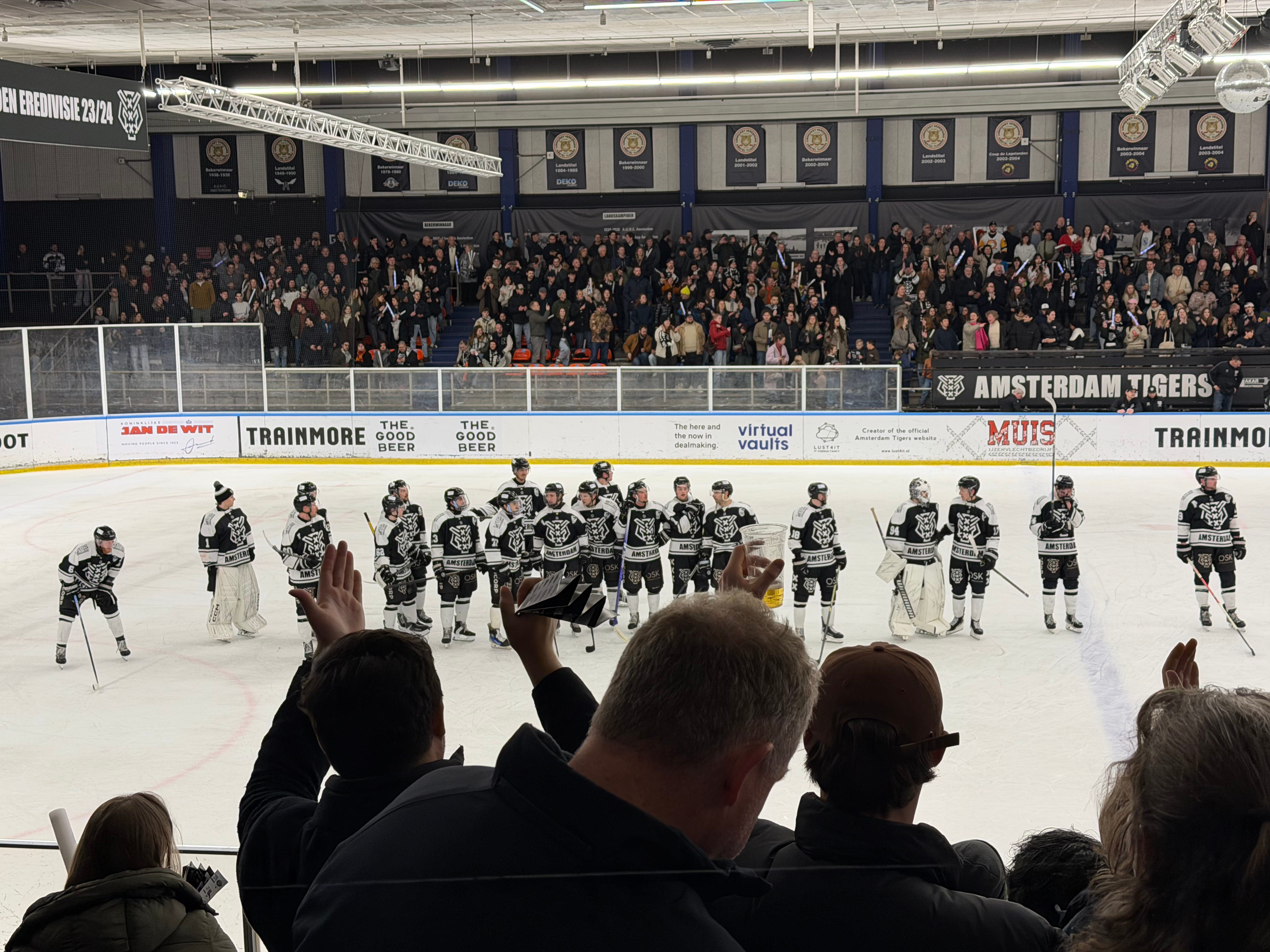
One night later the Tigers won Game 2 to sweep the series, the semifinals are this coming weekend.
After the game, as we walked out of the building, we chatted with an American who now lives nearby in Utrecht, she helped us find the right bus. She’s originally from Colorado, but has been in the Netherlands for a handful of years now and found a hockey community she didn’t know existed when she made the move.
And that’s one of the coolest things about all of this to me, the way something connects us whether we are playing or watching. It’s really a dumb game if you think about it — a rubber disc we whack around with sticks while strapping knives to our feet? — but no matter how dumb it might seem, there’s something that draws you in. Maybe it’s the combined speed and beauty of the game, maybe it’s the gladiatorial feel of it all, either way, there’s something that draws you in and connects you, spoken language be damned.
Enjoyed this, thanks. And Happy Anniversary
Congrats on the anniversary to you both!