

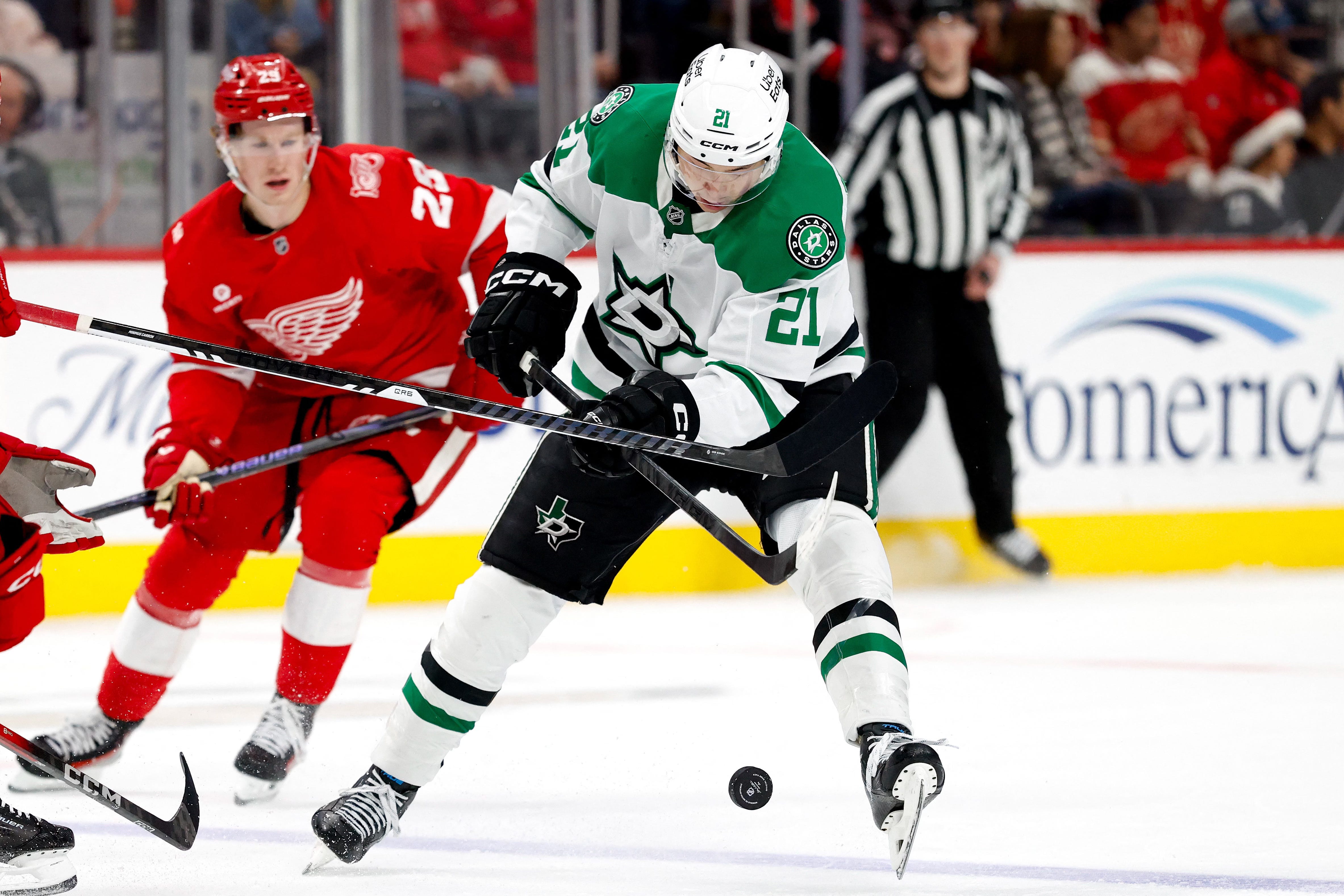
Jason Robertson won’t be going to the Olympics.
We all kind of knew earlier this month, when Michael Russo broke down Bill Guerin’s likely thinking in a well-reported piece. Those in the know in Stars land hinted it at earlier this week to me while I was in Minnesota for the World Junior Championships, and Robertson himself found out officially on New Years’ Eve.
But the rest of the world, officially, found out Friday morning when the American Olympic rosters were announced as part of a Today Show presentation.
As you’ve read and probably made the point yourself, Robertson’s 2025 was certainly deserving of Olympic inclusion. For the calendar year he was second in the NHL with 45 goals, the most amongst Americans — funnily, Morgan Geekie is the only player with more goals in 2025 than Robertson and he is also not going to the Olympics.
Robertson, which I’ve covered before, is a quirky player to classify. He’s a goal scorer, that’s indisputable, but the rest of his game gets overly painted in one direction or the other.
For the anti-Robertson camp, which includes Guerin, there’s not enough checking and defensive details in his game. He’s a one-trick pony, as one NHL executive told me, and Olympics requires stallions, not ponies.
For the pro-Robertson camp, he’ a very good defensive player. Analytically speaking, Robertson grades out well as someone that can play in all situations.
The reality lies somewhere in the middle, he’s a middling defensive player in my view, but more than good enough to be one of the top-six American forwards because in my view, a good offense is also a pretty damn good defense.
We’ve buried the lead nine paragraphs deep, but if you missed the headline here it is — what if Jason Robertson never really had a chance to make Team USA.
Sure, Robertson was invited to Team USA’s orientation camp in the summer, but the reality of the situation is he was only making the Olympic team with a cataclysmic collection of injuries.
Reputation, right or wrong, matters, and once you’ve got one, it’s hard to ever beat the charges that you’ve been saddled with. This is true in all facets of life, obviously, in this case an Olympic hockey roster is just providing us a case study.
And in this case, Robertson was doomed by a two reputations that couldn’t co-exist — his and that of USA Hockey.
USA Hockey’s crowning moment, back in 1980, set an ethos that a team doesn’t need the best players, but rather the “right ones.” Forty-five years, and zero Olympic golds later, Team USA still overly embraces the underdog mentality and belief that when building an Olympic team “roles” are the most important thing.
This is where critics will argue, and I’m here for it, that good teams, championship teams, have checking lines and players that understand their roles. That you can’t succeed without players willing to put in the work.
And that’s completely true in the NHL, because of the salary cap you simply can’t put together a roster with the 12 best forwards on the planet.
But in the Olympics, where there is no salary cap, you can just put together the best possible roster. You don’t have to build a team by NHL rules and regulations, it’s OK to think that maybe, just maybe, simply controlling the puck more than the other team on all four lines might not be a bad strategy to scoring goals — which is how they determine who wins, by the way.
On paper, Team USA should be the second-best team going into the Olympics —maybe the best if you consider the goaltending discrepancies between them and Canada. It’s OK to be one of the favorites, it’s OK to act like it and it’s OK to build a team where based purely on depth you should control possession.
But that’s not how these teams are built. They’re built by NHL ethos and built in the Olympic spirit of 1980.
USA Hockey took so many lessons from the team that won in 1980, but seems to have forgotten, now as a hockey world power, you are also allowed to take lessons from the Soviet Union team that won every other Olympic Gold between 1964 and 1988.
Picking Jason Robertson would have been a break from tradition, it would have been acknowledging that maybe your “roles” are flexible and that the coaching staff was competent enough to find one of those “roles” for the top American scorer from the past 12 months.
But that’s not how this works, nothing Robertson did or could do would have made a difference. His reputation was set, but more importantly, USA Hockey was already too far set in its own ways.
I hate how right you are on this because it makes omitting Robertson even dumber.
I understand the "players who know their roles" argument, but I disagree with it on the Olympic stage. It is rather demeaning to say one of the great players representing his country would refuse to flex their style a bit for the greater good of a gold medal. USA Hockey's mindset is stuck in a previous era of the sport and they won't win gold until they adjust.