

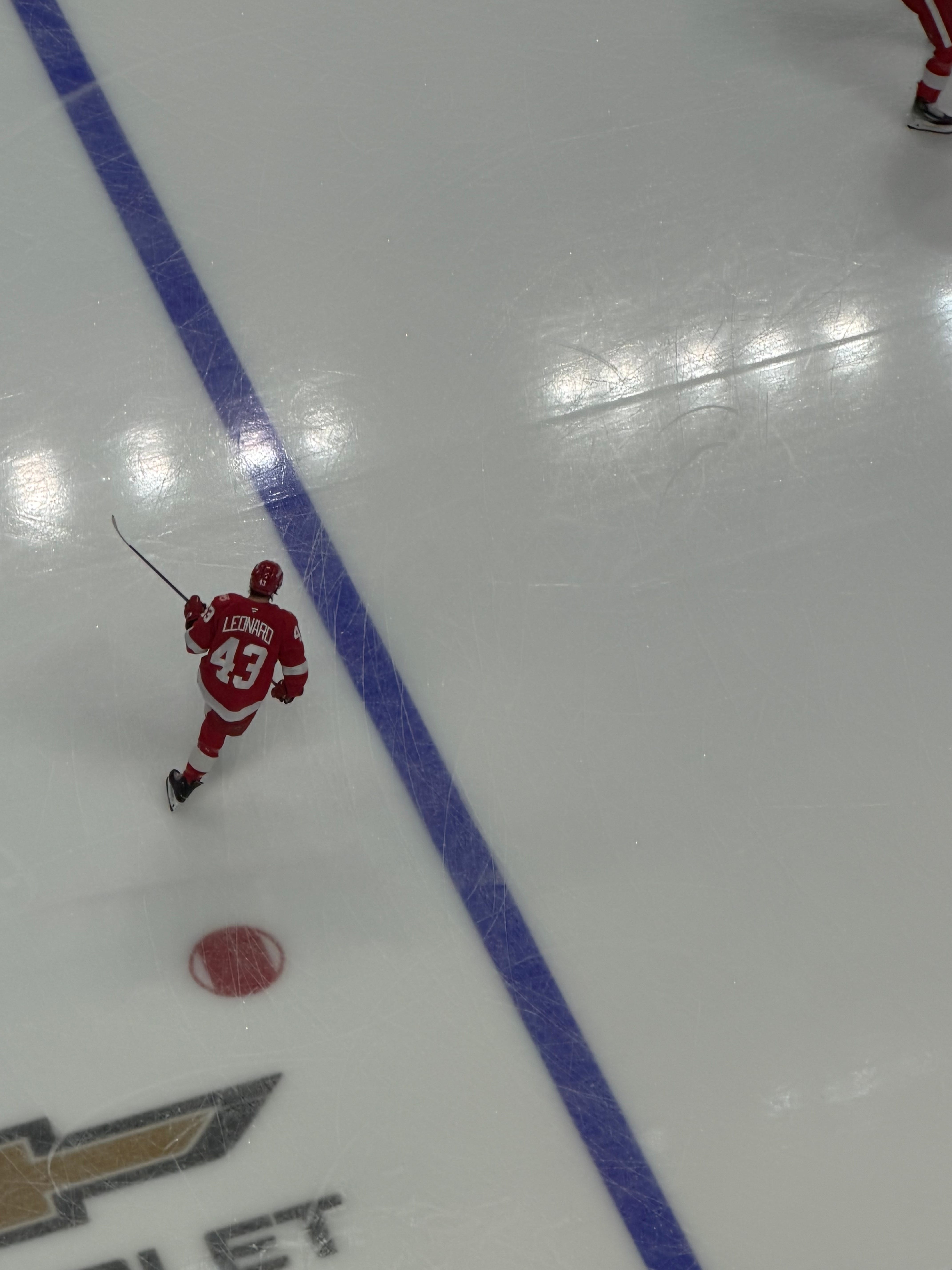
John Leonard made his Detroit Red Wings debut on Tuesday against the New York Islanders.
A bit of a journeyman, Leonard last played in the NHL during the during the 2023-24 season as a call-up for a team that was once known as the “Arizona Coyotes.” Leonard was on the Red Wings second line, filling in for Patrick Kane, and this season has been one of the AHL’s most efficient offensive forces with 29 points in 20 games for the Grand Rapids Griffins.
It’s a good story, it really is.
It also comes with a bit of irony because Leonard was wearing No. 43, when Red Wings fans had been clamoring for a different No. 43.
We, of course, are talking about Quinn Hughes, who was moved in a blockbuster trade this past weekend from the Vancouver Canucks to the Minnesota Wild.
One of the top defensemen on the planet, Hughes is a former Norris Trophy winner and was the captain in Vancouver. He has 433 points in 460 career NHL games, including a goal in his Wild debut, and will represent Team USA at the Olympics, likely anchoring the top power play unit.
Players like Hughes are hard to find and even harder to trade for, which is why the Wild unloaded a package that consisted of a Zeev Buium, Marco Rossi, Liam Ohgren, and a 2026 first-round draft pick.
In Detroit, it felt like a missed opportunity, especially with the rumblings that Hughes, a Michigan native, would like to return home and maybe, just maybe, that be the locale that would get his two brothers out of New Jersey as part of a long-term family reunion in four or five years.
The Red Wings, according to multiple reports, were at the negotiating table for Hughes, but couldn’t get it across the line. While it hasn’t been confirmed or denied by the Red Wings, and Steve Yzerman will likely never speak on it publicly, the public belief is that Detroit was unwilling to include Simon Edvinsson in the deal.
Hughes then went and said that he value what Wild general manager Bill Guerin did, how he has “a lot of time for Billy, for ‘sacking up’ and making the deal like he did. How he valued me.”
This turned the knife in New Jersey, for obvious reasons, but it also led to some consternation in Detroit, where even local talk radio — in the middle of Detroit Lions season — looked at those comments as a direct shot at the Red Wings general manager.
It’s a fascinating dynamic, for various reasons, and there’s been some really interesting reporting on the topic, including this piece from ESPN’s Greg Wyshynski that lays out some of the timelines and specifics on potential deals.
I’ve waited to write on this deal because I needed time to digest it myself.
Personally I’m a big fan of Edvinsson’s game, and as someone who watches him regularly and has seen his development up close in Detroit, it can be easy to become enamored with his game and future potential. But I also struggle to find a reason, personally, why he would be the deal breaker when it came to getting an established 26-year-old superstar.
Even if the deal included Michael Brandsegg-Nygard and Nate Danielson or Marco Kasper, there’s certainty that Hughes provides that Detroit may never find within their prospect pool.
It’s easy for me to connect things to Dallas, and I did chat with Stars general manager Jim Nill on Tuesday night — he was in Detroit scouting — but I’ll always remember last year he told me he might have 10 years of first round picks, and would likely never get to draft a player like Mikko Rantanen.
Yzerman after compiling and compiling and compiling, had a chance to work from a stockpiled asset position and didn’t. And if he had, even if the trade rocked the prospect pool or even decimated it, dropping Quinn Hughes into this Detroit team would have instantly turned them into a contender in the middling to mediocre Eastern Conference.
This also connects to something that I’ve thought often about watching the Stanley Cup playoffs in recent years. Hockey is a weak-link sport, in my view, in the regular season. Your depth gets you to the playoffs, but it becomes a strong-link sport in the postseason and I challenge you to find me a Stanley Cup champion in the past five years that didn’t have a superstar driving them when games really mattered in June.
OK, now that we’ve talked about the missed opportunity, it’s also important to talk about something we often miss when it comes to trades and what could or couldn’t have happened.
We don’t truly know the internal values the Canucks and Red Wings have on their players.
Consider the following:
Axel Sandin-Pellikka is a really good young player, really fun to watch, and I know Detroit likes his long-term projection, but I also struggle to put him on the same tier as Buium.
That entire paragraph is mix of reporting and analysis, it’s the truth as much as I can present it from what I know and perceive. It’s my perception of the deal, and with the hush-hush nature of how things operate with Yzerman, perception becomes our only reality.
It’s one of the reasons he can be untouchable for some fans — a god amongst us that is still fixing the sins of Ken Holland! — when my friend Max Bultman tweets that Detroit missed an opportunity after the Wild pounced.
Others, like some radio hosts I heard the past two days while driving around, are ready to burn their Yzerplan pompoms. It’s time to bring the vitriol, which is funny, because for the first time in what feels like forever the Red Wings might actually be a playoff team.
The truth here lies in the middle. The Red Wings did miss an opportunity, they also have had enough time to fail in this rebuild into a team that is competitive enough in a more watered down league.
And if that’s the case the question becomes this — if the Red Wings have moved past the draft lotto dice rolling, and they have, are they ever going to be bold enough to at least take a shot at something that puts them back into the NHL’s truly elite?
The Edvinsson thing is the old "A boat is a boat; but a mystery box could be anything! It could even be a boat!" Bit from family guy forever ago.