

I’m gonna open this piece with some self-plagiarism, because I’m not sure how I could beat this collection of paragraphs I wrote back in January:
The creaking can be unsettling.
Yet, it’s beautiful at the same time.
If you’ve ever skated on an amateur-made outdoor rink or pond, you’ve probably heard the sound. A creak in every direction, the tension of human weight on frozen water, and the half-second fear that your foot is about to dip into chilling water below.
And, yet, if you’ve tested the thickness well enough, it stays solid. You skate on, the sound of skates on ice, “kssh, kssh, kssh,” against a silent backdrop.
Very much like life, it’s broken and solid at the same time. Thousands of tiny fractures hidden below the surface, somehow holding it all together even it doesn’t make any sense.
That paragraph is copy/pasted from this story, which I guess no longer makes it self-plagiarism since I’m citing my old work.

Moving on, let’s actually drop some original thoughts here about the outdoor rink, why it matters to me, and why, this morning, the coffee tasted better.
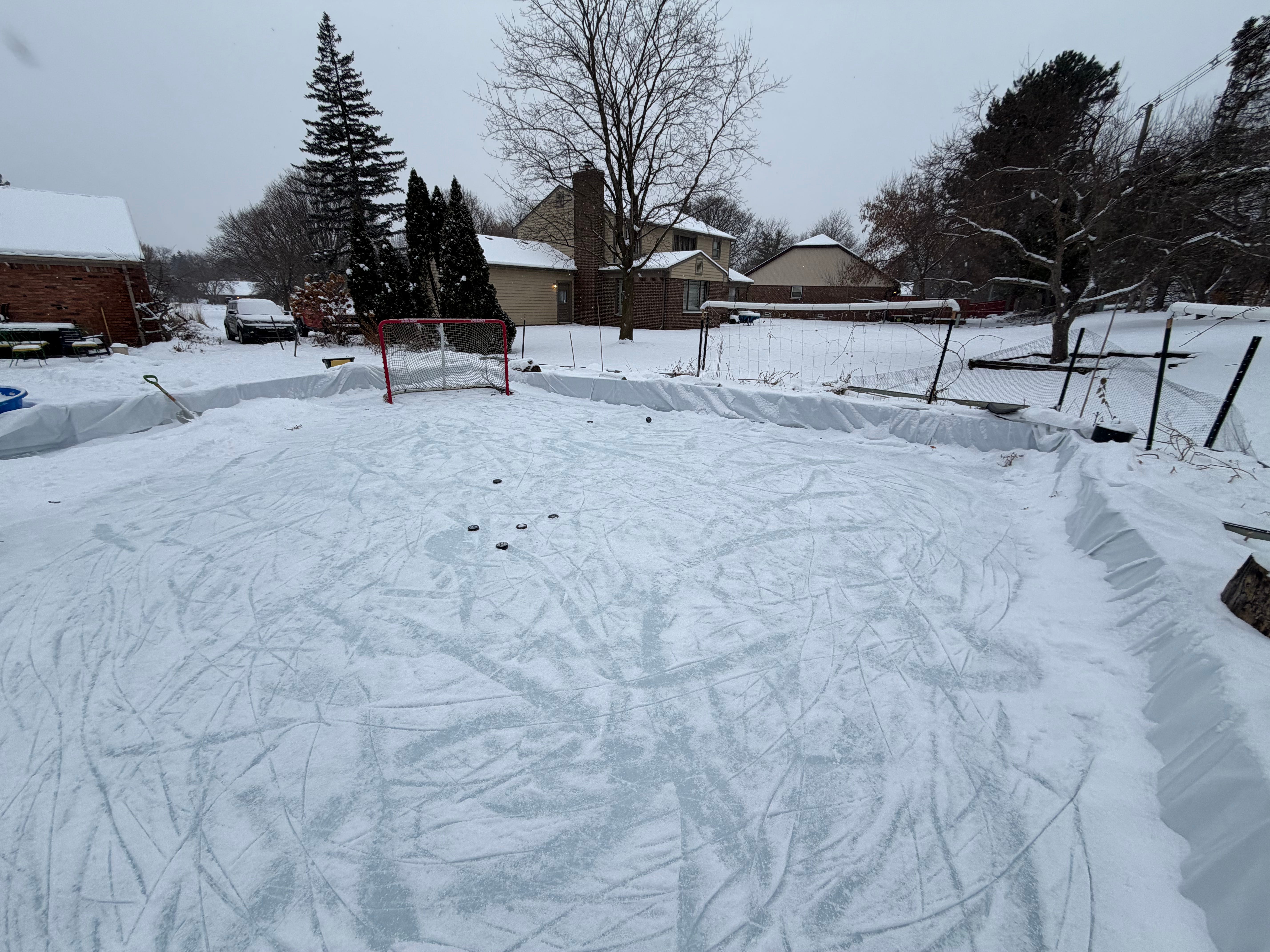
The rink sprung a leak this year.
I’m not sure where in the liner or how it happened, but sometime after it froze to roughly five or six inches thick, water started draining in the deepest corner. There was a slight cave in over in that corner and I was distraught.
I went from thinking this was going to be one of the best years for the rink, up and running in early December, to a fatalist view that the project was doomed and we wouldn’t get to skate at all in the backyard.
Take the regular and seasonal depression that I sometimes battle, and add a big old helping of disappointment, and you can only imagine the crushing feeling.
I wanted to panic, wanted to be alone and felt very empty.
Then my 5-year-old son asked if he could help fix it.
Kids are smart, smarter than we give them credit for, he could see his dad was upset — even if I wanted to hide it — and just wanted to help.
And then he helped more than you could imagine. We went outside, looked at the problem, and found a partial solution for the damaged corner — it’s become more of a snowbank — and in the process realized that, 75 percent of the rink was solid and ready.
I went from being distraught and disappointed, to running inside to grab his skates and watching him twirl around the ice for 20 minutes, with a huge smile that probably made his cheeks hurt.
That was Saturday. On Sunday, he skated again, this time with his sister, and they laughed and chased each other, played tag on ice. They didn’t care about a damaged corner, or that the ice is rougher this year than last, they still felt like they were flying.
One of the best things about having kids, I think, has been the perspective I’ve gained on the world. It’s taught me how to look at things differently, made me more compassionate and understanding person. It’s also made me a better writer, which isn’t something I expected.
In this instance, where a 36-year-old saw a problem, disappointment, a 5-year-old and 7-year-old simply asked how it could possibly be fixed and how we could look at this from a different angle.
We have a faulty tarp, but not faulty enough to destroy the entire build. We have some slopes and unevenness because of that, but at the end of the day, we still have a rink in our backyard and once you put your skates on, nothing else really matters.
I was thinking about that this morning after walking the kids to school, about how there are times I get so caught up in my own head, where an outside perspective on an issue would likely unlock a world of solutions. I thought about that on my walk home from the kid’s school, and then when I got home, I made another cup of coffee, put on my skates and shot pucks for about 30 minutes.
I’m not sure about you, but I love the moment where my brain feels like it’s turned off. It’s blank and reactionary, open to the world, but time tends to stand still and outside stresses or worries tend to drift away.
It’s one of the reasons I still play hockey twice a week, I love the camaraderie and the competition, but I also love how when I’m standing in the crease I’m unattached to rest of the world. I’m watching the play, obviously, and tracking the puck, but my brain is free to either shut off or wander, time can stand still, and life just feels right.
I get the same feeling when I step onto the ice in the backyard, a bucket of pucks clattering to the ice, the sounds of my skates — that “kssh, kssh, kssh” sound — and the occasional sound of a shot hitting one of the posts, a ping to the subtle symphony.
I lost track of time this morning, I have no idea how many pucks I shot. I was only pulled inside because I had set a timer on my phone, otherwise I never would have remember to come inside and get some work done — although I will sneak back out there today at lunch time to skate some more.
I’ve always said that we built the rink for the family, and that’s true. My daughter is already a better skater than I and my son will be, too. But selfishly, I think it’s OK to admit that we really built it for me, a place that’s both my happy place and now, thanks to my son, a reminder of finding a way to realize that even if the ice a bit bumpy, the second you put on your skates everything else can just melt away.