

Monday was a banner day, if we can call it that, for press conferences.
The Toronto Maple Leafs introduced John Chayka as their new general manager. At the introductory presser there was a semi-heated and awkward exchange between the Toronto Sun’s Steve Simmons and Maple Leafs president Keith Pelley.
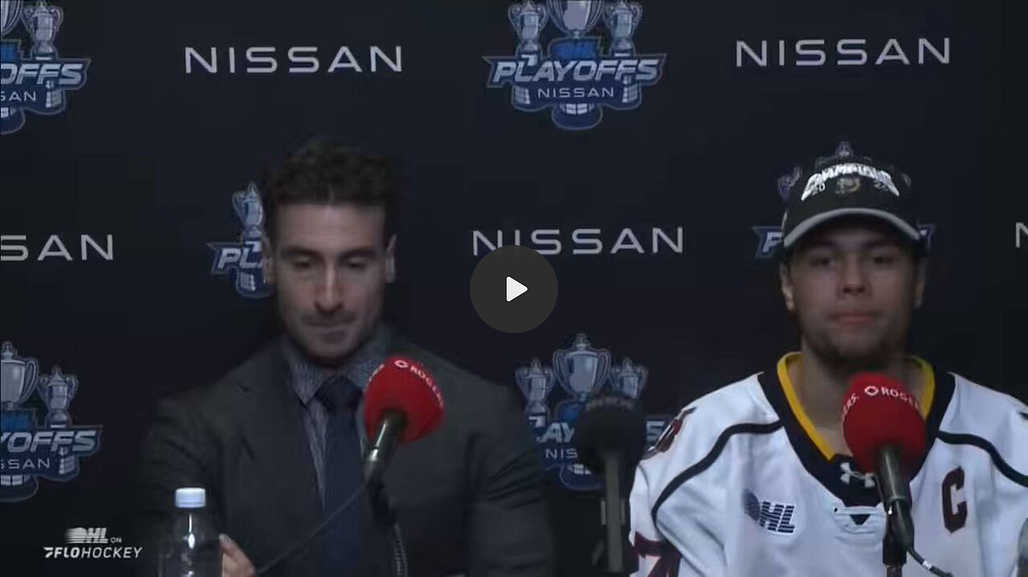
Later that evening, the Barrie Colts won Game 7 of the OHL’s Eastern Conference Final and in their post-game press conference, featuring head coach Dylan Smoskowitz and captain Kashawn Aitcheson, every single question was answered with “no one cares, work harder.”

I have thoughts on both of these pressers, and maybe we’ll get into them a bit more, but first I want to talk about what the press conference was and what it’s become, especially in a time where I think media literacy on the subject is at an all-time low.
Press conferences, at their core, are about information. It’s a space where initial information is presented “hey we hired this person” or “this team won or lost,” and then media members have the opportunity to gather new information through a series of questions.
I’ve covered thousands of press conferences in my career, I’ll be at one tomorrow in Detroit for example, and most tend to follow this formula. Even the highly dramatized ones yesterday, at their core, followed this line of thinking with media members attempting to learn and digest new information, ideally to better share the overall story in writing or video later.
It’s supposed to be an exchange of information, potentially contentious at times, but in theory a proper press conference helps lay the groundwork for a better story.
That hasn’t been completely lost, but in many ways the press conference has become the more important product than the story. A sort of live theater where many of the participants, on both sides, care more about personal gain from often live-streamed event.
Let’s start from the media side, where in today’s “look at me,” culture, many people care more about having their voice heard than listening to the answer of their question.
The Simmons’ question yesterday is an ideal example of this, because while the core of the question wasn’t wrong “why did you hire this guy?” the delivery was steeped in proving that the reporter was just as important as anyone sitting at that table. On top of that, if you were going to go down that line of thinking — which again, at it’s core is completely fair — why wouldn’t you ask Chayka a similar version of the same question when he’s sitting right there?
There are less extreme examples of this in every presser. Reporters or media members doing their best to prove how smart they are in their questions, and sometimes entering these events with pre-scripted questions, with long soliloquies, that hopefully draw compliments on social media later.
It then becomes a bit self-fulfilling, where younger reporters and those trying to break into this field, feel that in order to establish their voice they must win the press conference. That asking questions that come with an eloquent delivery, or potential virality, are the measure of acceptance in this business.
Adding to that slippery slope many of the best questions in my mind, the so-called dumb questions, are the ones that get dunked on in social media by Twitter trolls.
I’m not here to give advice, but in my experience, I’ve been able to tell better stories because I was willing to be ignorant in interviews, and it’s why when I attend a presser I typically wait until the end to ask for the microphone because I prefer to ask follow-up questions about something I didn’t understand from before.
Let’s hop over to the other side of the microphone, to the coaches, executives, and athletes who have the information and are doing their best job to control the narrative one way or the other.
After Barrie Colts won Game 7, they wanted to present an image of a team that didn’t care about anyone else’s thoughts or feelings on the series, hence the string of “no one cares, work harder,” answers.
The streaming partner for the OHL, FloHockey, celebrated the presser on Instagram by calling it aura farming, and there were many others on social media that celebrated the approach as well.
The Barrie Colts got the reaction they wanted, and I would bet seeing others calling it aura farming on social media will only encourage them to take a similar approach in the future, especially when it was the head coach and captain driving the bus on this.
It’s an extreme case, but it’s a prime example of what the press conference has become and how it’s evolved from an information-gathering session to clip farming.
And while we are admittedly talking more about the Barrie Colts today because of that clip, the reality is that fame really muddles the entire story. Barrie was down 3-1 in that series, came back to win in Game 7, and instead of chatting about that aspect of this, the larger narrative is whether they are or aren’t assholes.
The same thing happened with Simmons and his question to Pelley. Because of the phrasing and approach, the larger narrative isn’t about whether Chayka is or isn’t the right hire in Toronto, but rather whether Simmons is a dick or not. His written story in the Sun becomes a minor footnote, which for some reason didn’t include the part of his question about how he polled 20 anonymous hockey people on the hire and only one was in support of hiring Chayka.
I’m not perfect, I’ve asked many overly-worded questions at press conferences. In fact, I’m sure you can go back to the Red Wings press conference from last week and find a question I botched. But I’m also fine with that and I’m fine with not being the smartest person in the room, and maybe that’s our long-lost thesis here. When everyone is trying to prove how smart or how self-important they are in these settings, we simply lose the actual stories worth telling.
Ask them why either being an A-hole, or hiring a A-hole, is considered acceptable in front of kids or grandmothers... another example of social media degrading common decency. Both sides.
I'm not a journalist! Let's get that out there first. For me, this is a Dale Hansen/Randy Galloway type of situation where they believe they're the smartest people in the room in their minds, and their collective smartassedness sarcastic mode of operation would always shine through. Say something so provocative that "it" becomes the story, rather than the press conference, in this case.
I don't pretend to understand the media scrutiny that lives in and surrounds the Maple Leafs in Toronto, but I do know there are people in the media who feel like they, and they alone, are the moral compass for an organization they cover. They've lost the plot, and can no longer hide their bias and belief that they are in fact the smartest person in the room. It's unfortunate, because it reflects on the rest of the journalists just trying to scratch out a living in the trying times the media lives in.
I can only imagine that asking questions in a setting like this can be difficult, just ask Bob Sturm who famously can weave a two minute array of words into a question sometimes. Don't get me wrong, Bob is great, but wanders and meanders at times to get to his point or actual question. It's even turned into a bit at times on The Ticket, IYKYK.
For the Toronto reporter who appears to be butt hurt over the selection of Chayka, that dude needs to do some soul searching and figure out how to not do personal attacks on someone he likely doesn't even know, but "he" doesn't agree with because he decided he carries the moral weight of an entire organization.
I would never want someone to lose their job, as I just lost mine, but if he loses his credentials to cover the team, it wouldn't be shocking, and it may even be deserved, who knows for sure.
I clearly have too much time on my hands right now, so forgive my rant, but I absolutely despise people that try and make a story about themselves even if they are too dumb to realize it