

For the second time this season and fourth time in the past three years, I took the kids to a PWHL takeover event in Detroit this past weekend.
Like the three prior games, which I’ve written about before, it was a blast and I’m hopeful that sometime in the not-to-distant future they’ll be a team in Detroit.

I will have something from the emotional/fandom view up tomorrow, a story that relates to my daughter and connecting with her favorite player and what the PWHL can represent in that manner.
But today I want to write about tactical hockey things that the PWHL often makes me think about.
There a couple PWHL rules that I wouldn’t mind, in principal, being adopted by the NHL and other leagues.
The PWHL uses a “jailbreak” rule when it comes to shorthanded goals. If a team scores shorthanded, the penalty is over, the ultimate double-whammy on a penalty kill.
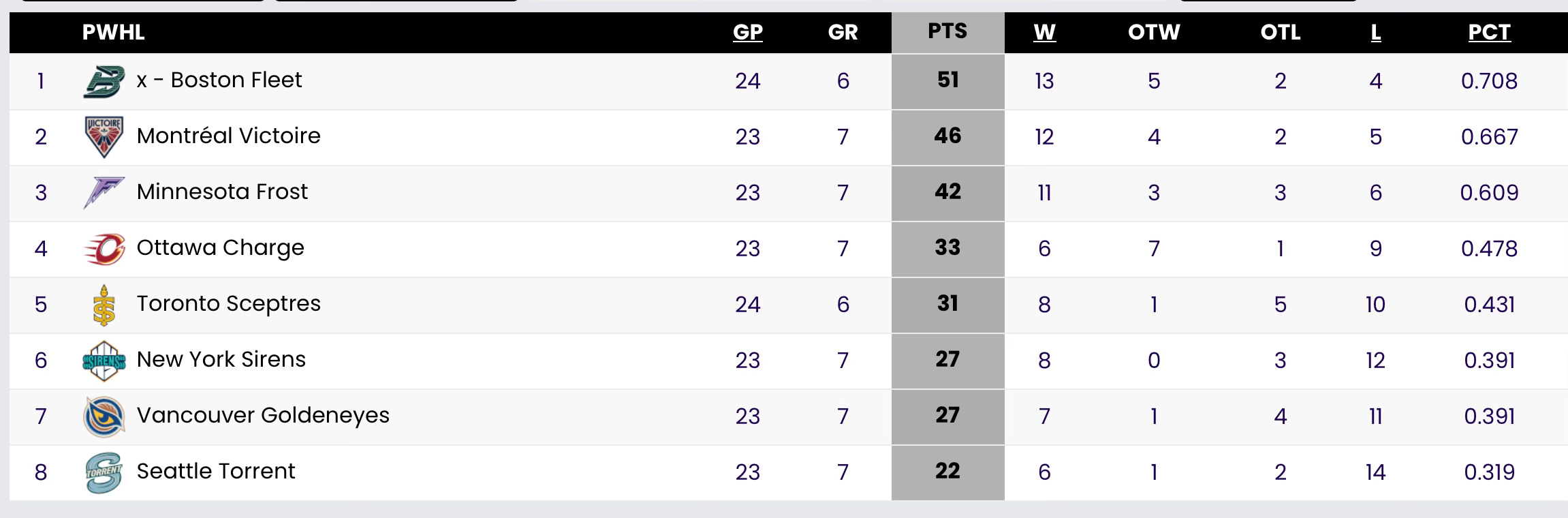
The league also uses a 3-2-1 point system, where teams get three points for a regulation win, zero for a regulation loss, two for an overtime win, and one point for an overtime loss.
It creates a standing page that looks like this.
From a talking head perspective, both of these changes seem simple enough, right?
A 3-2-1 point system is more fair, each game is created equal and worth the same amount of points, and if potentially applied to the NHL it could be a good counter to the dreaded slogfest we often get in a tied cross-conference game where both coaches have decided the overtime point is worth more than taking risks for a regulation win.
I was curios to ask a PWHL coach if these rule changes impact how they do their job. Are more risks taken in the PWHL in tied games or when shorthanded because of the rules we laid out?
So I asked Montreal Victoire coach Kori Cheverie, the reigning PWHL coach of the year, about it after her team practiced in Detroit on Friday.
“I guess it would depend on where we were at in the standings and the time of year,” Cheverie said. “If we needed the three points and it was do-or-die for that, you might make some late game adjustments to be more aggressive. But otherwise, it’s hard to get points, and that’s how you set yourself up for the playoffs.”
“I think it becomes similar to how you look at games in a season, when you aren’t playing your best game, don’t have your A game, what does your B game look like and can you still get points?” Cheverie said. “So unless it’s really an all-or-nothing for the three points, I think it doesn’t change how you approach the game as a coach.”
What about the jailbreak goal? Does that make teams more aggressive on the penalty kill?
“I think there are some teams that look at it that way, but our main focus on the penalty kill isn’t to score a goal,” Cheverie said. “We focus on being aggressive as we can be in moments the make sense, but really going for a shorthanded goal or a chance is more of a cherry on the top if you can get it. It’s not worth it to push for a goal on the penalty kill and then have a 5-on-2 coming back the other way.”
Cheverie did say some players have naturally become more aggressive on the penalty kill because of the opportunity, but overall, the rule isn’t one that changes the way her team plays.
Personally speaking, I like both rules, I also like the PWHL’s pick-your-opponent rule for the postseason where the top-seeded team gets a proper reward for regular season standings — unlike the NHL’s current format.
I personally love both rules from the fan perspective. On the PK it just makes it that much more exciting, and nail-biting. An extra element to the game. And the point system to me makes a big difference. I can't stand when at the last few minutes of a tied game, it seems sometimes like both teams are just coasting through to make sure they each get a point.
On the subject of the PWHL in general, their games are amazing. We went to the game they played here in Dallas this season and it was so much fun. I really hope we get a team here in the near future!!
Great read… love the jailbreak SH goal rule, first I’d heard of it! Yea, coaches are so conservative by nature… any rule to get them more aggressive I’m in favor of, and I bet the players are too… unless their team sucks :))).